Start with two players and one locked console
One player wants games without paying for authorization; another wants to run software they wrote themselves. The same technical barrier can affect both, but their purpose and impact are not interchangeable.
The lesson asks what platform holders are trying to protect—sales, licenses, online services, code integrity, and user data—and then traces what happens when a particular check fails.
We will move from an application bug through several documented console cases to Secure Boot and generic SoC memory isolation. Each claim is bounded by what its source actually demonstrates.
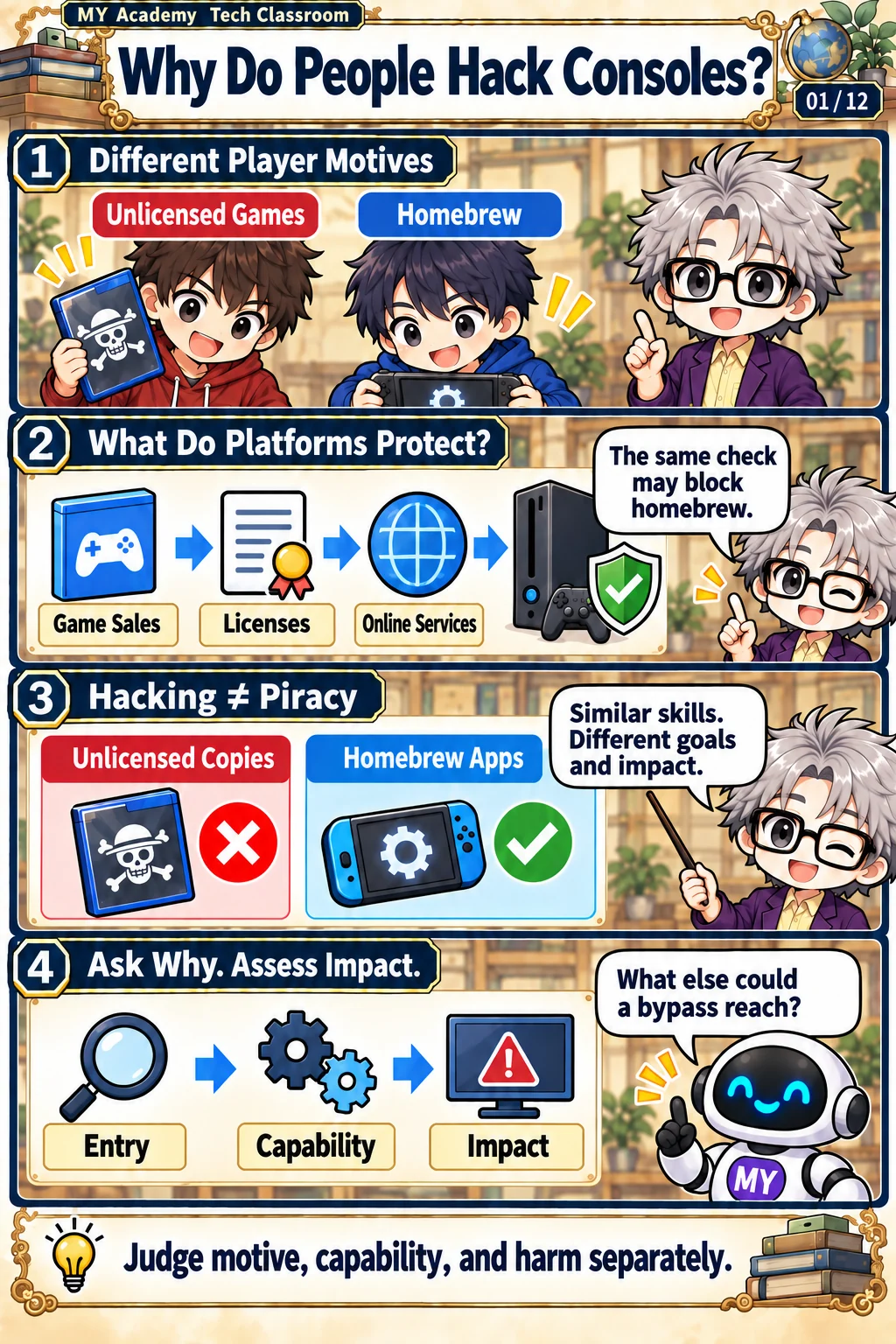
Why do people hack game consoles?
Console hacking can promise capabilities a platform normally restricts. Some people want games without paying for authorization, which can harm developers, publishers, and platform holders. Others want to run homebrew they wrote, study an operating system, preserve software, or build a feature the manufacturer did not provide. Similar techniques do not make those goals, legal status, or harms identical.
From a platform holder's perspective, a console is connected to game licenses, stores, update services, multiplayer, player accounts, and a developer ecosystem. Unauthorized copies can reduce game sales and licensing revenue. Untrusted programs may also affect cheating controls, services, account data, or device integrity. Those business and security reasons explain why platforms use media checks, signatures, and boot protections, but no single check solves every problem.
The word 'hack' is not a technical explanation. It does not tell us whether the entry was a browser, media parser, signing service, or boot ROM. Nor does it say whether the result was running homebrew, changing the kernel, reading data, or maintaining control of a device. We need to verify motive, capability, prerequisites, and impact separately.
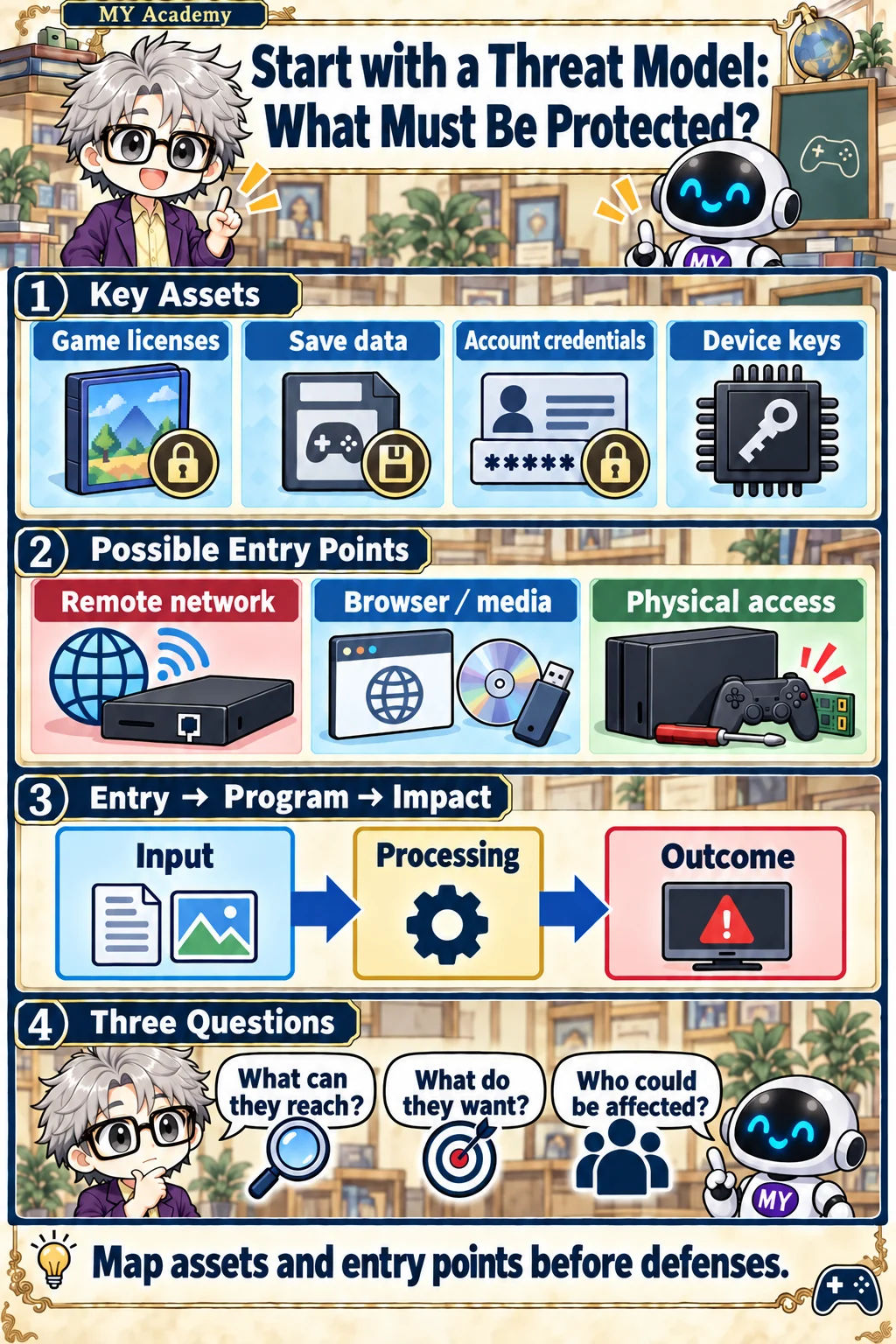
Start with a threat model: what is worth protecting?
A threat model is not a character sketch of a hacker. It is a way to make a defense question concrete. Start by listing assets: a game license determines what may run; saved data holds player progress and personal information; account credentials reach stores and online services; device keys may support encryption, identity, or security functions. Which asset matters changes both the appropriate control and the meaning of a compromise.
Next describe what an attacker can reach. A remote network attack requires an exposed network service. A browser or media parser may receive web pages, images, game content, or removable media. Physical access may include the console, its ports, or changeable hardware. These capabilities are not interchangeable: evidence of a physical-access issue does not establish a remote attack.
Finally ask what could happen. Could input crash a process? Could it affect a constrained application? Is there another flaw that permits privilege escalation? Is there evidence of access to accounts, online services, or secure-world keys? Listing prerequisites and outcomes prevents a headline like 'the console was hacked' from turning possibilities into proven results.
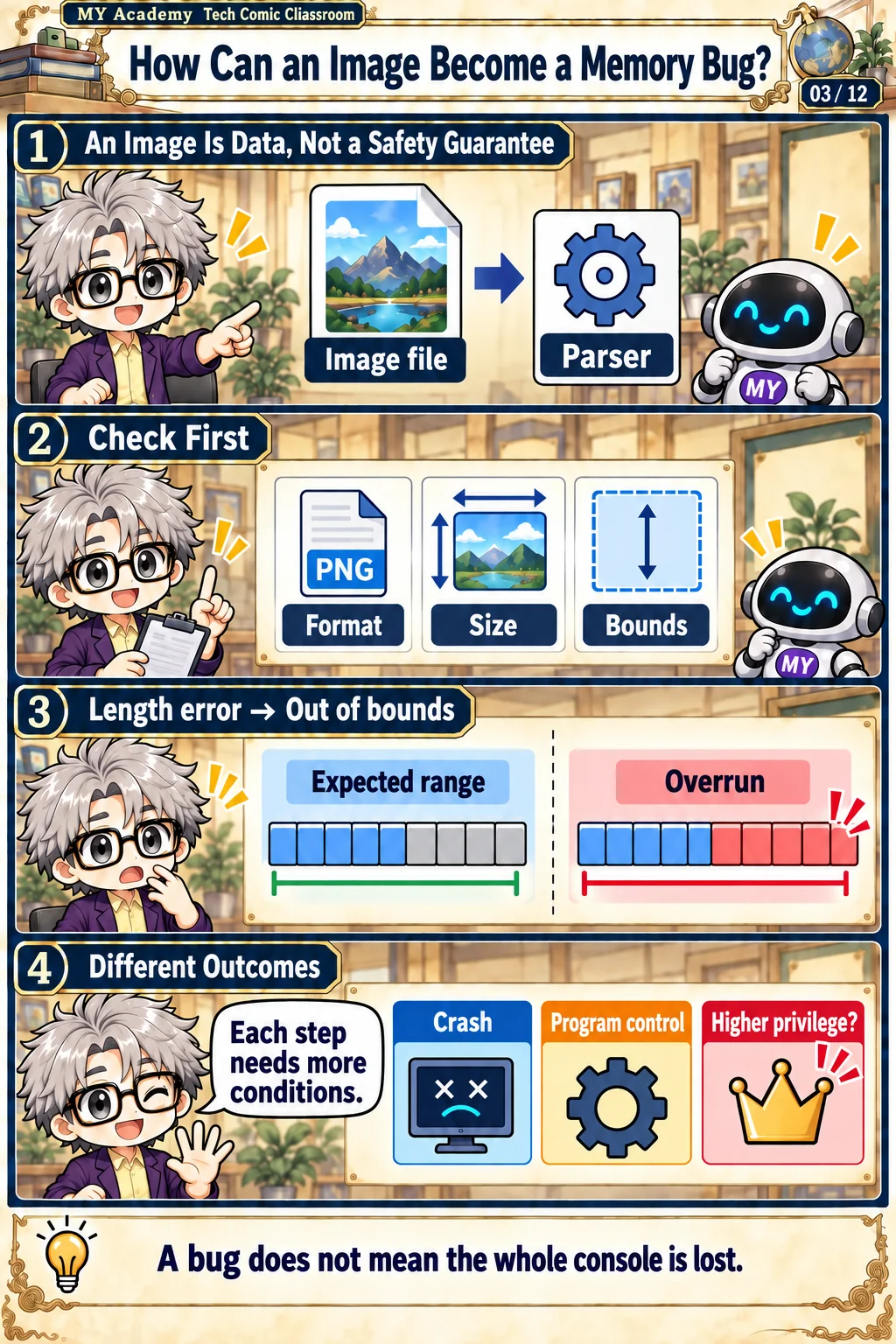
How can an image become a memory bug?
When an application opens an image, it passes file bytes to an image parser. The parser interprets headers, dimensions, color information, and data chunks, then places processed results in memory. Even though the input looks like a picture, software still has to handle lengths, formats, and boundaries carefully.
Imagine memory as labeled boxes. A program requests a region and should work only inside its boxes. If it miscalculates a length, a write may go beyond the reserved region and affect nearby data. That can cause a crash or corruption; under particular conditions it may affect control flow. The analogy helps show the boundary error, but real layouts and exploitability are more complicated.
Do not compress every outcome into 'a bug means control.' A crash only means the program cannot continue normally. Code control means an attacker can influence execution. Privilege escalation must cross another operating-system boundary. Reaching a kernel or trusted execution environment usually requires additional privileges, another weakness, or a flawed hardware isolation setup. Each step needs separate evidence.
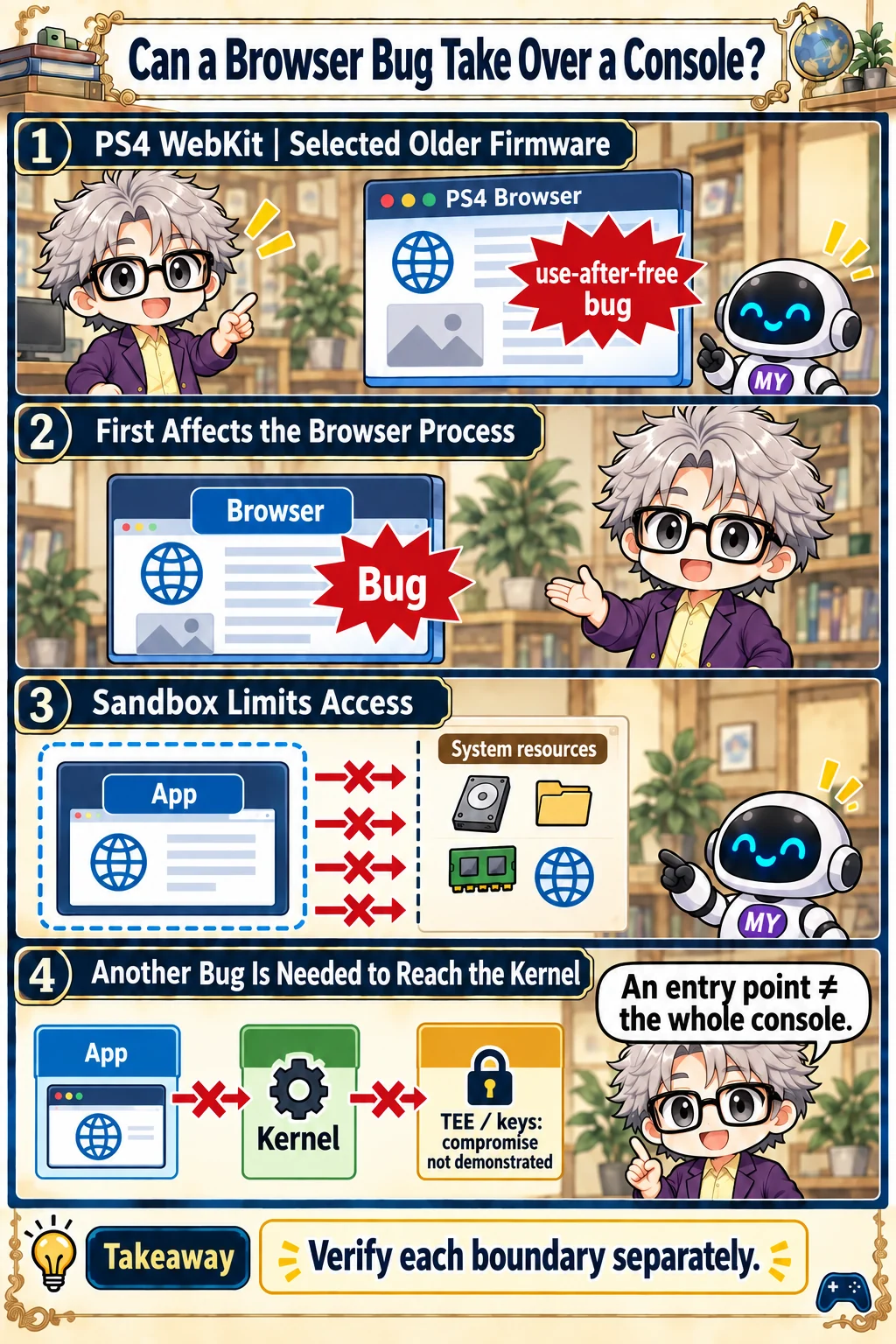
Does a PS4 browser bug compromise the whole console?
Synacktiv researchers analyzed a WebKit use-after-free on specific older PS4 firmware. A use-after-free occurs when software releases a memory object and later uses an outdated reference to it. Such an error may affect the browser process, but the researchers describe the browser as sandboxed; an application-level entry point does not automatically grant control of the operating system. [1]
A sandbox is a restricted workspace. Even if a process misbehaves, the files, services, and system functions it can normally reach remain limited. To move from the browser process into the kernel, an attack chain needs another condition that crosses the next boundary. Synacktiv's account of some older-firmware chains includes a separate kernel vulnerability, so the browser bug and later privilege escalation must be taught as distinct stages. [1]
This case does not prove that the PS4 TEE, secure world, or hardware keys were compromised. Each boundary is a separate claim. Also, we have not found reliable evidence for the remembered PS4 photo-viewer stack overflow. A different public PS5 image-library record cannot be used to fill that gap: the platform, time, and vulnerability claim differ. [2]
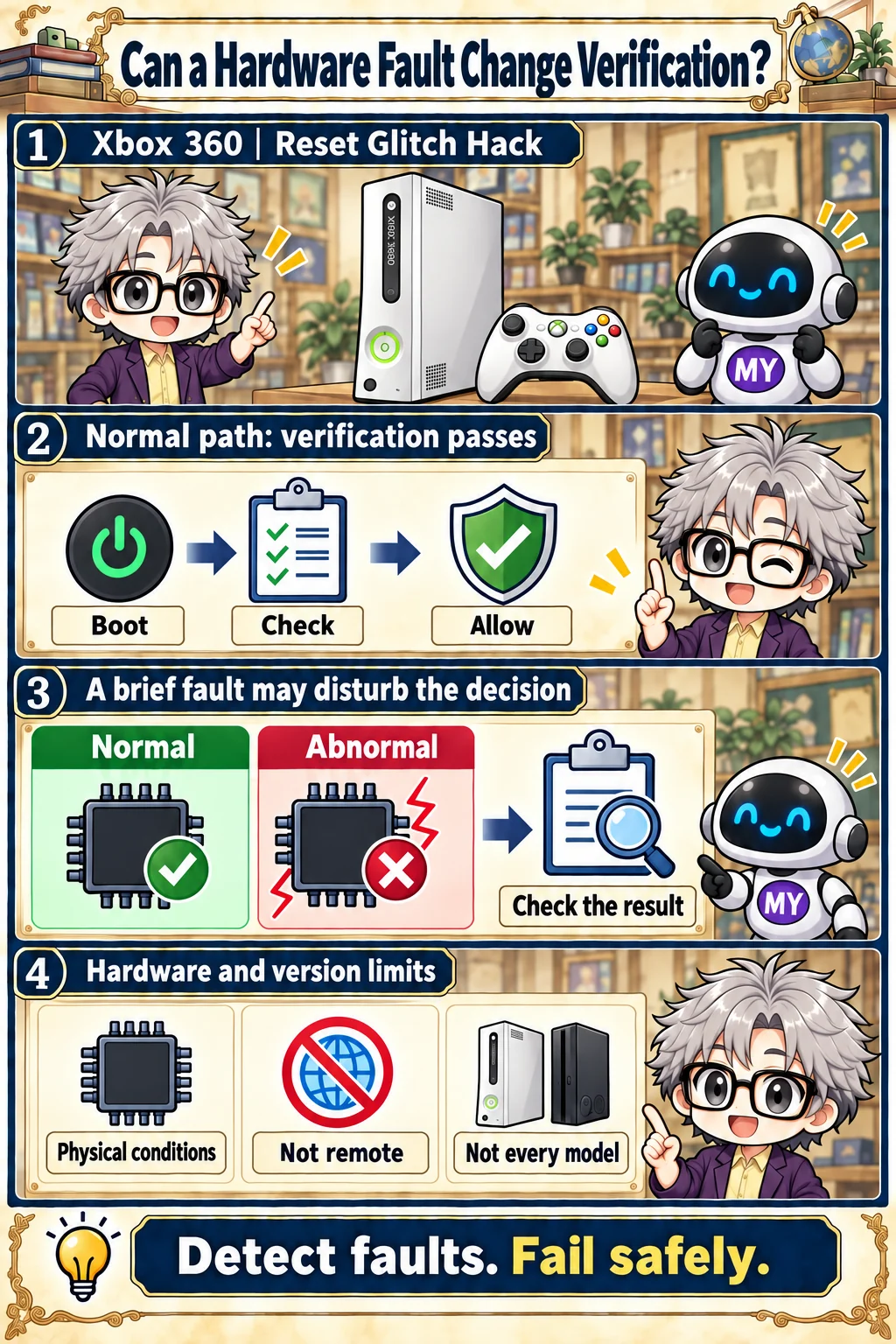
Can a hardware fault change a verification result?
Software bugs are not the only way to affect a trust decision. The Xbox 360 Reset Glitch Hack is a documented historical research case showing that hardware behavior during boot could influence validation. Researcher GliGli describes a transient hardware fault affecting a particular boot-time decision. We only need the security concept; there is no need for signal timing or modification instructions. [3]
Think of a referee checking a document at a critical moment. The normal flow reads, checks, and then permits or rejects the next program. If hardware deviates briefly at that moment, the verifier may observe the wrong state. Security therefore has to consider physical conditions such as power, clock, reset, and error handling, not only the logic in a software branch. Not every fault produces the same effect.
The case is bounded by motherboard, chip revision, and later protections. It does not apply to every Xbox 360 model, and a physical-condition study is not a remote attack. Designers can test safe failure states, repeated checks, fault detection, and recovery. The broader lesson is that trust decisions depend on how the system behaves under abnormal hardware conditions.
Can correct signature math still fail in practice?
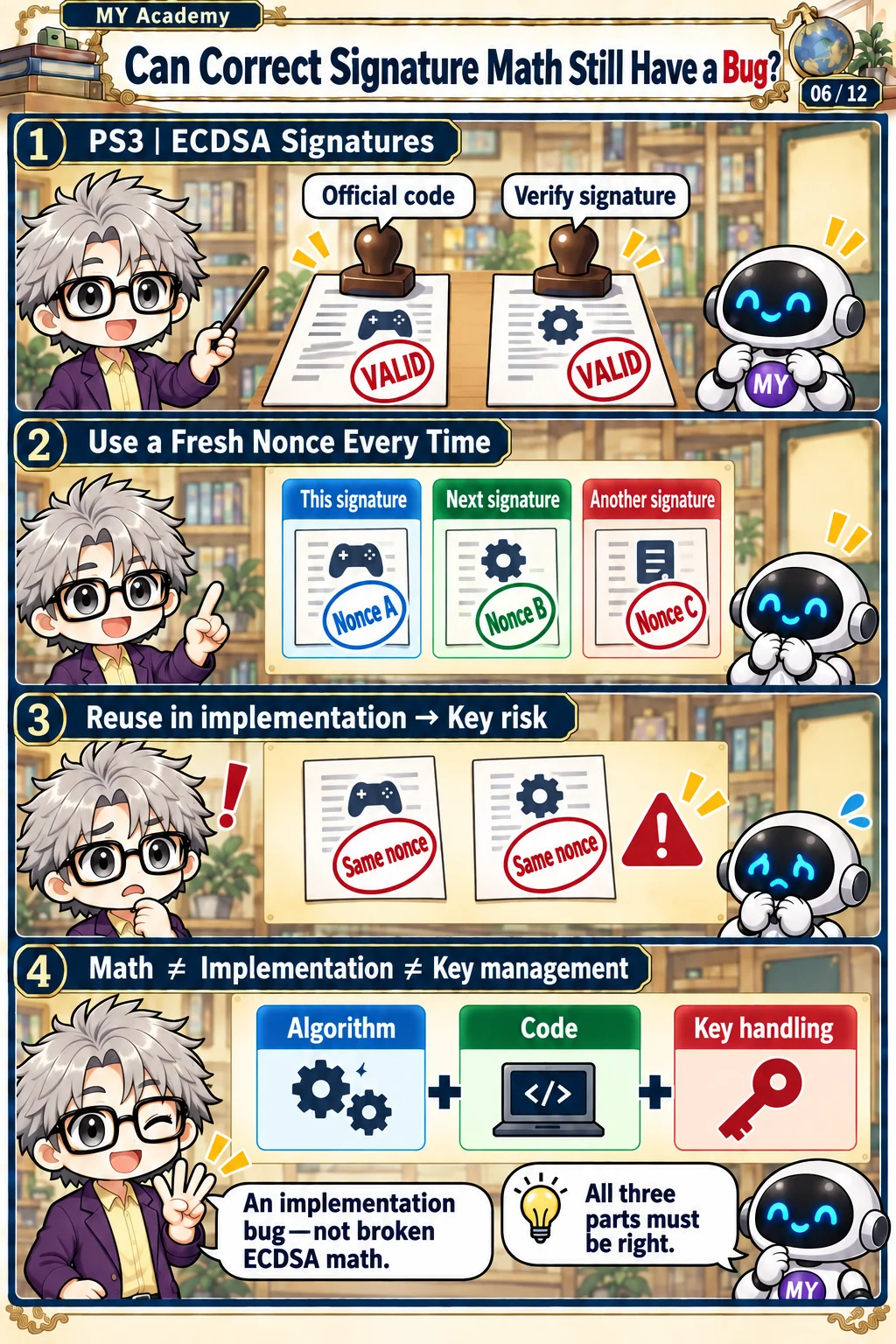
The PS3 signing episode is often shortened to 'elliptic-curve cryptography was broken.' A more accurate lesson is that ECDSA implementations must handle a temporary value correctly for each signature. Improper reuse undermined the signing security even though the underlying mathematics had not simply stopped working. The 27C3 talk and contemporary reporting describe an implementation failure. [4][5]
A signature is like an authorization stamp: a verifier trusts a program when the signature follows the platform's policy. But even a sound stamp design fails if the signer repeatedly leaks information that should remain private. Trust therefore depends on the algorithm, its implementation, generation of temporary values, and the storage and lifecycle of the signing key.
Defense needs several checks: select an appropriate algorithm, use a reviewed implementation, avoid sensitive temporary-value reuse, protect the signing key, and plan revocation and updates. This lesson does not reproduce key-recovery mathematics or key material. Understanding which layer failed is enough to see why algorithm selection alone is not a complete security argument.
What if the chip's earliest ROM misreads input?
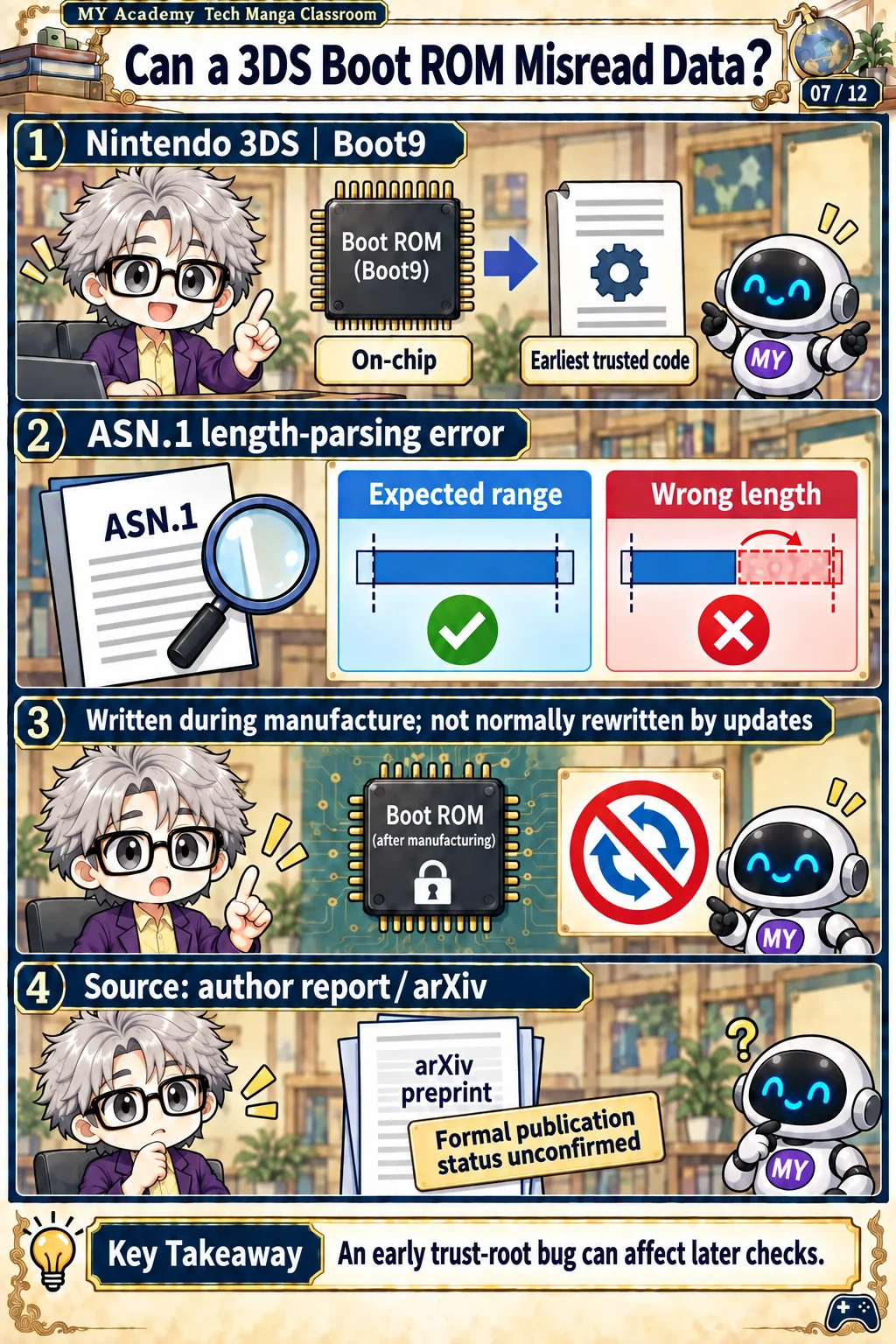
Boot ROM is code that runs early after power-on and often establishes the first trust point before loading later software. Its advantage is that ordinary programs cannot easily rewrite it after manufacture. But 'stored in the chip' only means replacement is difficult; it does not mean the code is free of programming errors. A parser defect in an early verifier can make later trust begin with a wrong decision.
An author technical paper on the Nintendo 3DS Boot ROMs describes an ASN.1 length-parsing issue in Boot9 and analyzes its effect on signature validation. ASN.1 is a data-encoding format with type and length information. The reader must correctly determine where each field starts and ends; a flawed length check can make the verifier misunderstand those boundaries. The available record is an author paper / arXiv preprint, and its formal publication venue has not been confirmed here. [6]
An ordinary system update generally cannot rewrite factory-burned ROM code. Designers should keep early parsers conservative, validate lengths and formats rigorously, and test failure paths. They also need to control where data is copied, who may modify the relevant memory, and whether the next stage verifies what it receives. A root of trust matters precisely because remediation may be more constrained.
Switch and Tegra: what are the limits of a BootROM flaw?
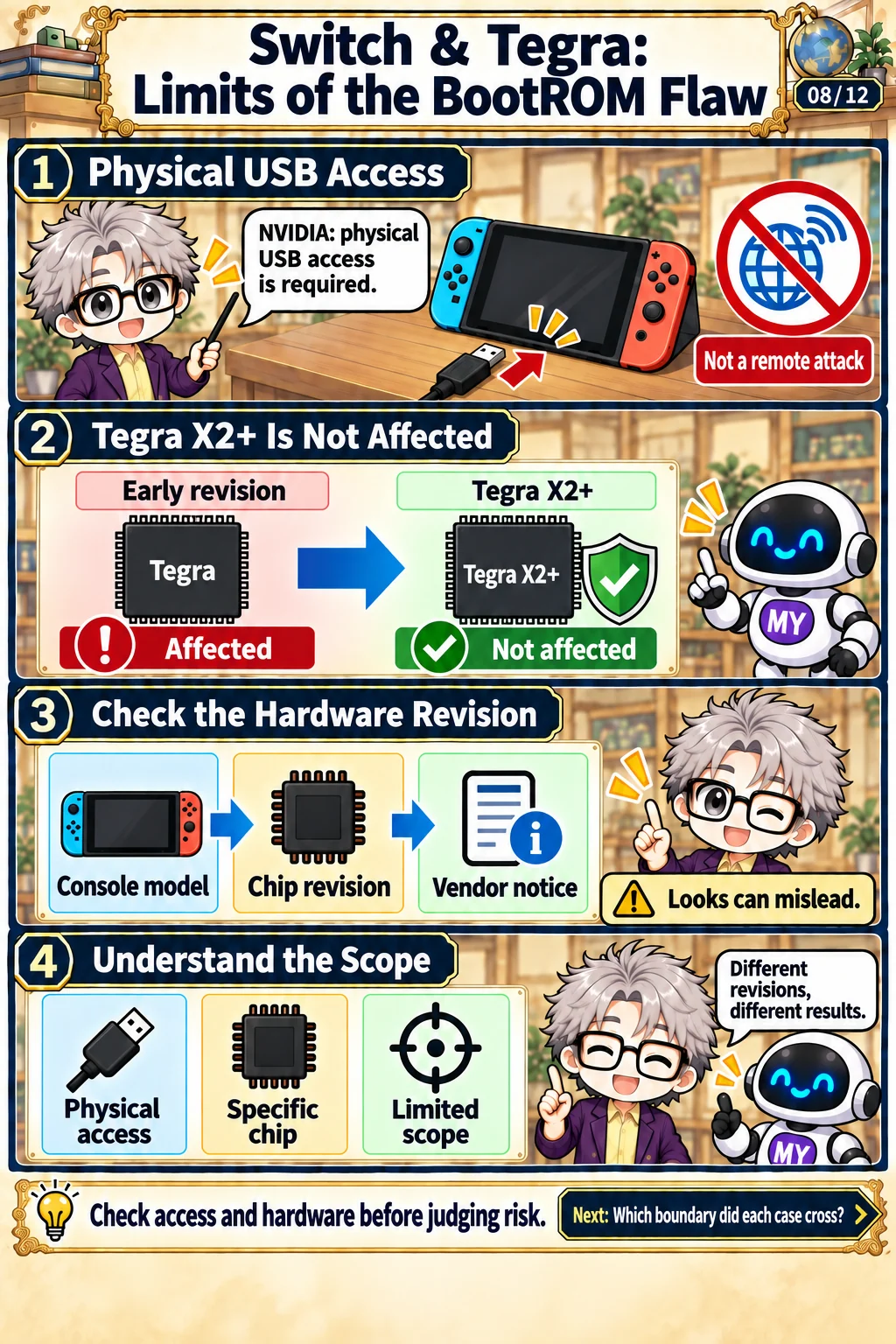
The Tegra case related to Switch is a useful comparison for early-ROM risks, but NVIDIA's notice sets important boundaries. NVIDIA says the RCM vulnerability requires physical USB access; it is not a remote-only attack. The notice also says Tegra X2 and later products are not affected. [7][8]
Those limits are part of the threat model, not footnotes. A physical-access requirement creates a different risk from an internet-reachable flaw. A chip revision outside the affected scope cannot inherit the same conclusion. The Switch family spans production periods and hardware versions, so the product name or appearance alone does not establish that every unit uses the same chip or is affected.
Updates can repair updateable firmware or add mitigations for early defects, but they do not turn factory ROM source code into a different revision. Product design must plan for hardware variants, recovery, and continuity of trust. This classroom discusses public security implications and leaves out reproduction steps.
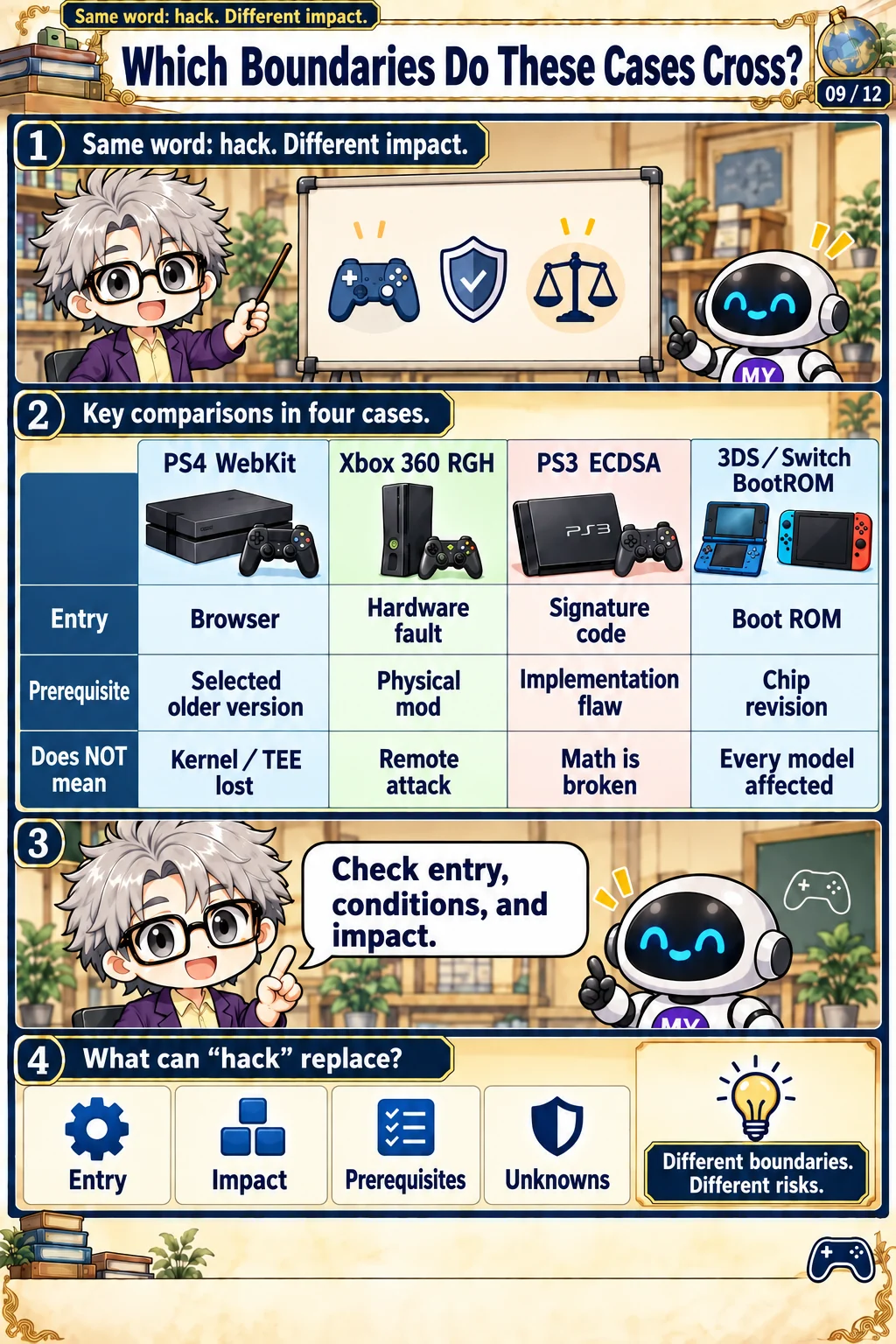
Which boundary did each case cross?
Compare the cases: PS4 WebKit is an application entry on specific firmware; Xbox 360 RGH shows hardware faults may affect boot-time validation; PS3 involved signature implementation and key-management failure; 3DS and Tegra show that early Boot ROM code and conditions can be security-critical. The technical causes and prerequisites differ.
When reading a report, ask: where is the entry point? Does it require a network, particular media, physical access, or firmware version? Which component's decision was affected? Was execution demonstrated, kernel access, or only a crash? Which assets have evidence of exposure? These questions turn a vague 'hack' into a testable account.
Technical capability and purpose also differ. Homebrew capability may support preservation or experiments, but similar access can be abused for unauthorized copies or cheating. A vulnerability may also enable malware. Unless case-specific evidence establishes intent, do not infer every researcher's or player's motive from a technical finding.
What does Secure Boot protect?
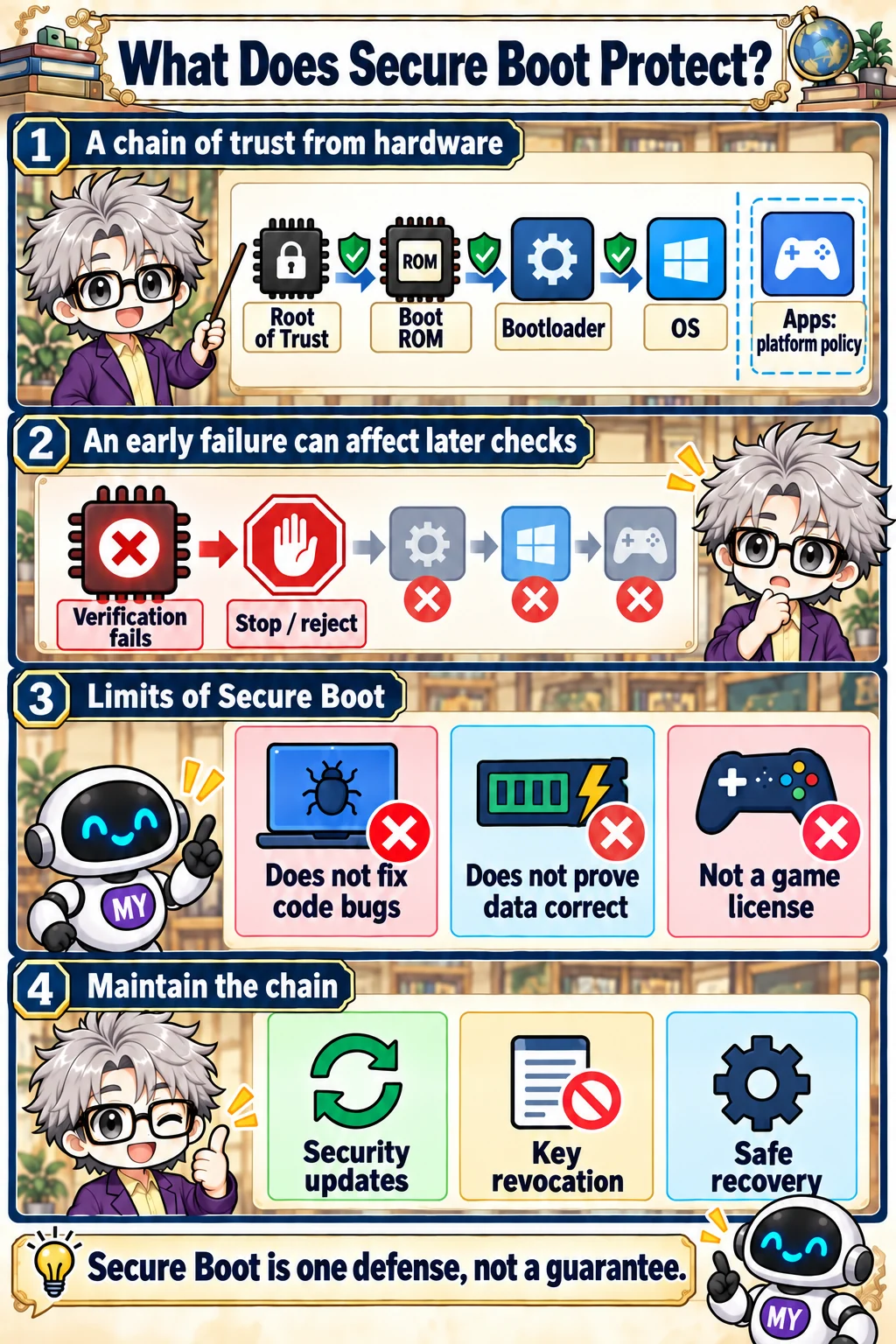
Secure Boot controls which programs may continue during startup. A Root of Trust checks the first verifiable stage; after passing, that stage verifies the next one, extending through bootloader, operating system, and other components. Depending on the platform, signatures, hashes, and policy determine acceptance.
This makes it harder for an attacker to modify stored firmware and have an unauthorized or altered image go unnoticed. But the verifier must itself be trustworthy, keys must be protected, and policy must support revocation and updates. Authorized code may still have a parser flaw or runtime defect. A valid signature says the image satisfies an authorization and integrity policy; it does not say the software has no bugs.
Secure Boot cannot replace game licensing, online identity checks, application sandboxes, memory protection, or recovery. Its question is whether the next program meets boot policy—not whether that program is vulnerability-free. A robust product also needs safe rejection, security updates, key revocation, and recovery after a failed update.
How can memory isolation keep ordinary code away from a key?
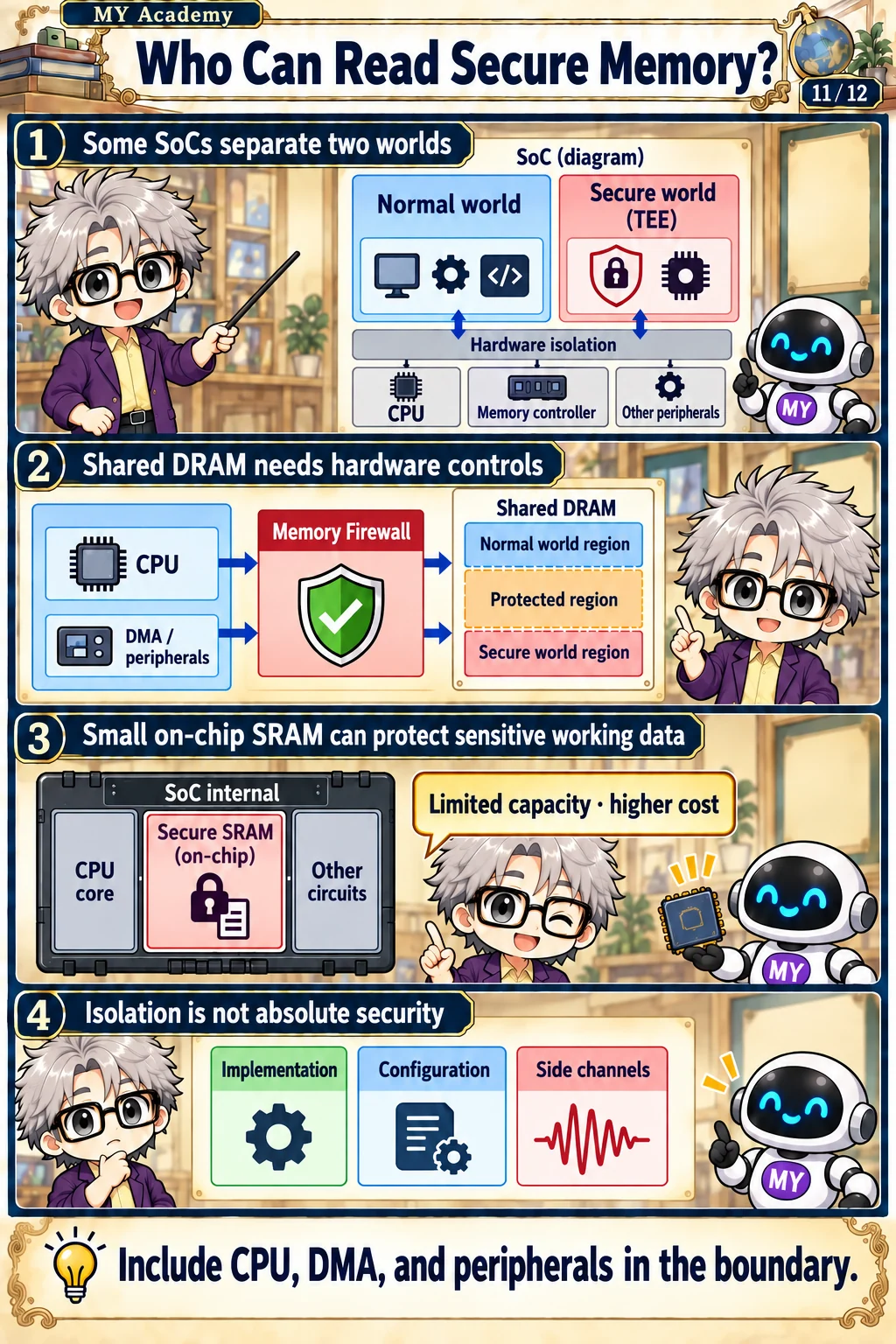
Now move from console cases to a generic SoC design. If an image parser in the normal world receives hostile input, we want a bug there not to expose storage keys or private security data. TrustZone and a TEE provide a useful architecture example using Normal and Secure Worlds; however, our sources do not prove that every console in this lesson uses Arm TrustZone. We are explaining generic SoC principles, not attributing a design to a console. [9]
Isolation is more than naming a region 'secure.' If worlds share external DRAM, hardware such as a memory firewall must enforce which masters can access each range. DMA controllers and other peripherals may issue memory requests without the CPU copying every byte. The design must control relevant bus masters, memory regions, configuration registers, and initialization. Restricting the CPU but overlooking a DMA-capable device leaves another path.
Separate external secure memory sounds straightforward, but it adds components, pins, board area, and integration cost. Arm describes a common tradeoff: partitioning one external DRAM can cost less than using two smaller external devices; if the critical working set is small, some sensitive functions can instead fit in on-chip SRAM. This is not a universal security winner—capacity, access paths, and cost all matter. A TEE is still software and hardware that need secure interfaces and error handling. [9][10]
Design exercise: where should code, data, and keys live?
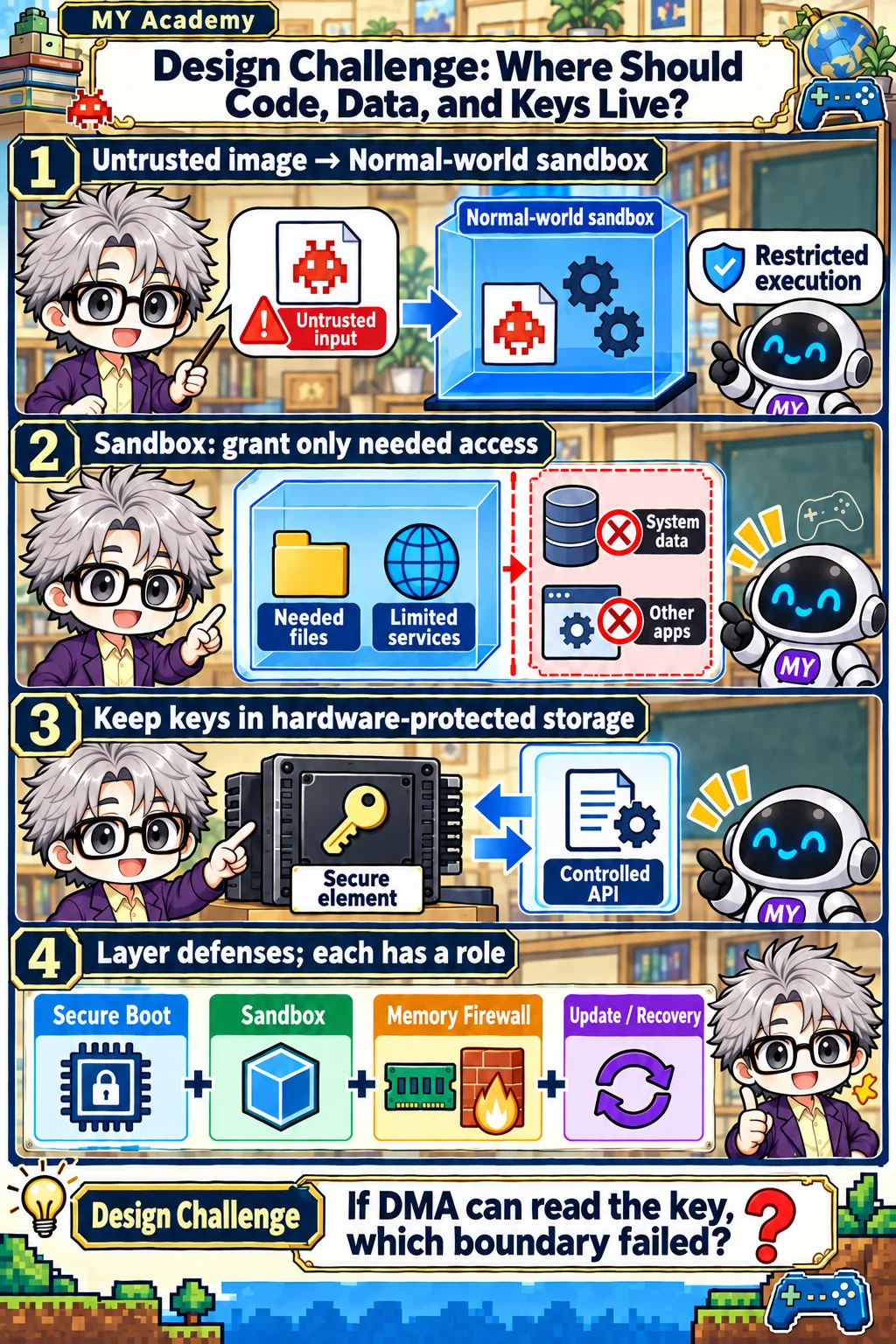
Return to the opening image. If the parser does not need a key, do not give it direct access to one. Keep it in a restricted sandbox and limit the files, services, and system calls it can use. If a function needs a secret, a narrow Secure World service can perform the operation for it, accepting only well-formed, bounded, validated requests instead of copying the key into ordinary memory.
At the same time, the memory firewall must constrain CPUs and DMA-capable masters. Every security service still needs protection against oversized requests, confused state, and invalid calls. Secure Boot verifies startup code; a sandbox manages runtime permissions; a memory firewall governs hardware access to memory; security updates and recovery handle known defects. Each control has a distinct job.
Finally, test the boundaries together. If an attacker controls the image parser, can a DMA device still read the secure region? If a security service receives an oversized or malformed request, does it fail safely? If a root key must be revoked, can the product recover? Security is not achieved by labeling components with reassuring names: engineers verify who enforces each boundary, how it can fail, and what happens next.
Five points to keep
- People may seek unauthorized games, homebrew, preservation, or research. Do not infer motive from a capability alone.
- A threat model identifies assets, attacker access, entry points, prerequisites, and impact.
- A crash, code control, kernel privilege, and secure-world key access are separate outcomes—not automatic steps.
- Secure Boot governs startup authorization; sandboxing and memory firewalls address different runtime boundaries.
- Memory isolation must include CPU, DMA, peripherals, configuration, and service interfaces; dedicated memory is a product tradeoff, not a universal answer.
Continue with the Secure Boot classroom to trace the trust chain from immutable root code through firmware verification and recovery.
References
- Synacktiv, This is for the Pwners: Exploiting a WebKit 0-day in PlayStation 4: Specific older PS4 firmware, WebKit issue, sandbox context, and separate kernel vulnerability in some documented chains.
- PS4 Developer Wiki, Bugs; libpng advisory GHSA-7wv6-48j4-hj3g: Used only to distinguish image-parsing attack surface and avoid treating a PS5-related record as proof of a PS4 stack overflow.
- GliGli, Reset Glitch Hack technical report: Original historical research context for Xbox 360 fault injection; this lesson omits reproduction details.
- 27C3, Console Hacking 2010: Original research talk on the PS3 signing implementation case.
- Ars Technica, PS3 hacked through poor implementation of cryptography: Contemporaneous reporting on ECDSA temporary-value reuse as an implementation failure.
- Scire et al., Attacking the Nintendo 3DS Boot ROMs: Author technical paper / arXiv preprint; formal publication venue has not been established in this lesson's source ledger.
- NVIDIA, Tegra RCM Security Notice: Physical USB access requirement and unaffected Tegra generations.
- Fusée Gelée disclosure: Original disclosure context for the Tegra RCM issue.
- Arm, Building a Secure System using TrustZone Technology: TrustZone/TZASC, shared DRAM access control, and on-chip SRAM design tradeoffs.
- Arm and GlobalPlatform, Trusted Execution Environment and TrustZone: Architecture context for TrustZone, trusted worlds, and DMA-related boundaries.
Experiment: which memory can a signed program read?
Verify an actual ECDSA boot signature, then calculate the complete range of a CPU or DMA request. Exclude normal DMA from the firewall and see the same secure-region request change from denied to permitted.
This is a policy model with a fixed 4 KiB address map, not a console, Arm TZASC or RTL bus simulation. Cross-region transactions are rejected as a whole. Master identity, DMA coverage, parser bugs and policy are supplied conditions. It omits caches, IOMMUs, side channels and exploits. A signature does not establish runtime safety.
Learning guide
How Trust Is Built Inside a Chip
Open the course outline → · Progress counts published lessons only
Prerequisites
- Console anti-copy mechanisms and basic threat modeling
What I learned
- Separate motive, capability, prerequisites, and impact
- Explain why app bugs do not automatically grant kernel or TEE access
- Distinguish Secure Boot from runtime memory isolation